


 Menu
Menu 

in accordance with the Regulation of the Council of Ministers of 8 November 2021 on the detailed rules and procedures for introducing restrictions on the sale of solid fuels and on the supply and consumption of electricity or heat
– Journal of Laws of 2021, item 2209, as amended.
Approved
Beata Kurdelska
President of the Management Board
Agnieszka Stachurek
Vice President, Member of the Management Board
Strategic Analysis and Planning Department
Szczecin, May 2024
CONTENT OF THE STUDY
1. Basis for preparation
2. General information
2.1 Characteristics of district heating operations
3. Technical characteristics of heat sources
4. Types and parameters of the heat transfer medium and methods of its control
4.1 Control table including heat output regulation at individual sources
4.2 Flow rate of the heat transfer medium
5. Types and technical parameters of the district heating network
6. Restrictions on heat supply
6.1 Classification of heat consumers
6.2 Consumers excluded from the restriction plan
6.3 Levels of heat supply restrictions
6.4 Planned maximum level of heat supply restrictions by supply source
7. Method of public disclosure of the restriction plan
8. Validity of the heat supply restriction plan for consumers within SEC’s operating area in Szczecin
1. Basis for preparation
The basis for the preparation of the ‘Plan for the introduction of restrictions on heat supply to consumers within the operating area of SEC Sp. z o.o. in Szczecin for the years 2024–2027’ is:
– The Regulation of the Council of Ministers of 8 November 2021 on the detailed rules and procedures for introducing restrictions on the sale of solid fuels and on the supply and consumption of electricity or heat (consolidated text: Journal of Laws of 2021, item 2209, as amended).
– The Act of 10 April 1997 – Energy Law, Article 11 (as amended).
– The Regulation of the Minister of Economy of 15 January 2007 on the detailed conditions for the operation of district heating systems (Journal of Laws of 2007, No. 16, item 92).
2. General information
Szczecińska Energetyka Cieplna Sp. z o.o., based in Szczecin (hereinafter: SEC or the Company), is an energy undertaking engaged in the generation, transmission and distribution, as well as the trading of heat, and in the generation of electricity. The Company’s registered office is located in Szczecin at ul. Zbożowa 4. The Company is entered in the Register of Entrepreneurs under KRS number 0000131910. The entry was made by the District Court in Szczecin, 17th Commercial Division of the National Court Register, on 22 October 2002. Currently, the Company is registered with the District Court Szczecin-Centrum in Szczecin, 13th Commercial Division of the National Court Register, under the same KRS number.
2.1 Characteristics of district heating operations
SEC conducts business activity related to heat supply on the basis of granted licences in the following areas:
- heat generation under licence No. WCC/40/167/U/3/98/AD of 7 September 1998, as amended,
- transmission and distribution of heat under licence No. PCC/42/167/U/3/98/AD of 7 September 1998, as amended,
- heat trading under licence No. OCC/16/167/U/3/98/AD of 7 September 1998, as amended.
SEC’s activities cover the city of Szczecin and the locality of Warzymice in the Kołbaskowo Municipality. The main heat consumers include housing cooperatives and housing communities. In addition, heat supplies also serve public institutions (schools, offices, churches) as well as commercial and industrial facilities.
The diagram of the district heating system managed by SEC is presented in Appendix No. 1.
3. Technical characteristics of heat sources
Within the city of Szczecin, the district heating networks are supplied by the following heat sources:
- belonging to SEC, i.e. CR-Dąbska, CR-Marlicza and CR-Sąsiedzka,
- from external sources, i.e.:
- EC Szczecin and EC Pomorzany (owner: PGE Energia Ciepła S.A.),
- ZTUO (owner: Zakład Unieszkodliwiania Odpadów Sp. z o.o.),
- CHP New Cogen (owner: New Cogen Sp. z o.o.).
The heat sources supplying SEC’s district heating networks are described in Table 1.
Table 1. Heat sources supplying SEC’s district heating networks
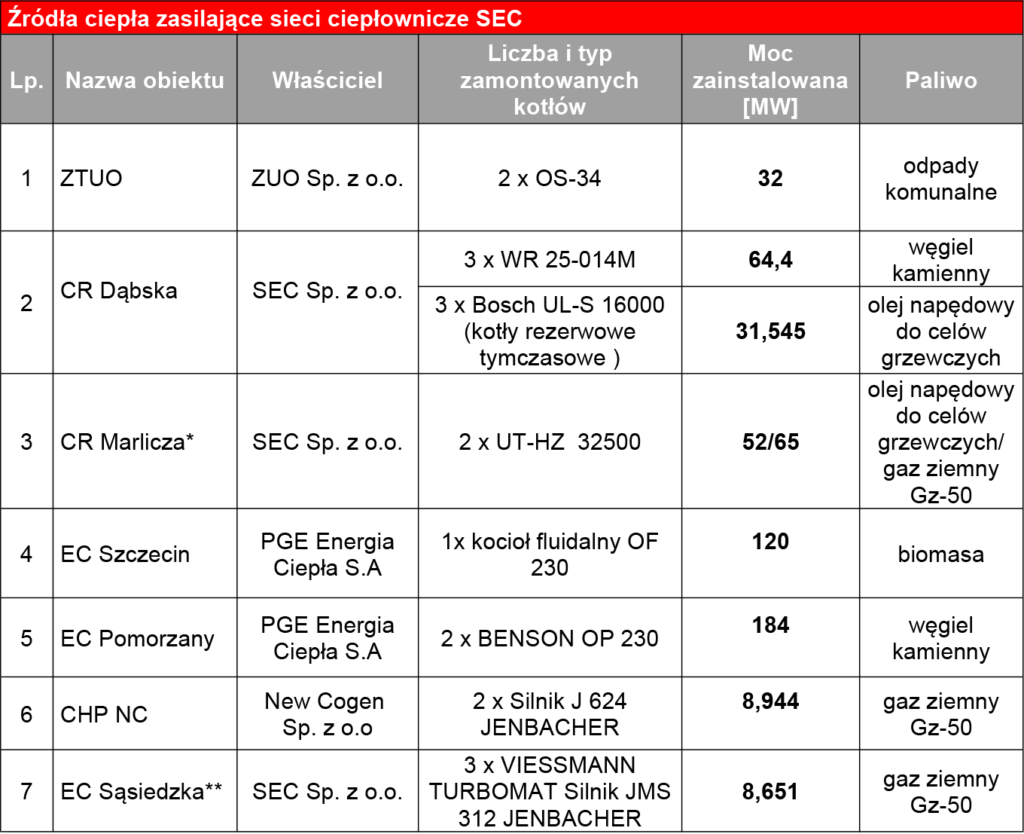
* In CR Marlicza, the boilers are equipped with gas–oil burners. Boiler capacity depends on the type of fuel used (52 MW – light fuel oil, 65 MW – natural gas).
** Gas-fired boilers serve as peak and emergency units. Depending on the operating schedule of the other sources and the current situation, the area supplied from EC Sąsiedzka will be supplied either using heat from the main district heating network or from EC Sąsiedzka.
In addition, SEC operates the “Policka” boiler house, which serves as a peak and reserve heat source and is the northernmost heat source connected to the district heating network. In the event of maintenance shutdowns or emergency outages of other heat sources, resulting in temporary shortages or reduced quality parameters of the heating medium, the “Policka” boiler house becomes a very important generation element due to its location. It can operate jointly on the common network with other heat sources or independently to supply a designated area within Policka, Sobola and Romana Streets. The Policka boiler house is currently fuelled by light fuel oil; however, it is intended to be supplied both with oil and from the gas network in the future.
4. Types and parameters of the heat transfer medium and methods of its control
4.1 Control table including regulation of heat output at individual sources
The heat transfer medium in the Szczecin district heating network is hot water with design parameters Tz/Tp = 125/65 °C and Tz/Tp = 115/60 °C (licence No. PCC/42/167/U/3/98/AD
of 7 September 1998, as amended).
Temperature control in the district heating networks is carried out as a function of the outdoor temperature.
For heat sources connected to the district heating network, control tables apply. On this basis, the SEC Heat Dispatch Centre (hereinafter: DMC) programmes the operation of the heat sources.
The operating parameters subject to programming include:
- the supply temperature of the network water [°C],
- the pressure in the supply and return pipelines [MPa].
Qualitative and quantitative control is applied in district heating systems. This means that the operation of heat sources as well as substations (depending on heat demand) may be regulated either by changing the temperature of the heating medium or by adjusting the flow rate.
Temperature control of the network water at individual heat sources is carried out in accordance with temperature tables, which take into account the relationship between the programmed parameters and the actual outdoor air temperature, as well as other weather conditions (including wind speed, cloud cover, solar radiation, etc.).
Based on daily forecasts from the Institute of Meteorology and Water Management (IMGW) regarding outdoor temperature, the operation of heat sources is programmed each day at 8:00 p.m. with respect to the set supply water temperatures leaving the heat sources and entering the district heating network.
On the basis of ongoing analysis of the outdoor temperature, it is possible to introduce adjustments to the supply network water temperature in accordance with the provisions of the heat supply and sales agreements concluded between SEC and heat suppliers.
The ordered thermal capacity, operating parameters, principles of controlling the operation of heat sources, and areas of responsibility with regard to maintaining quality parameters have been defined with suppliers in the heat supply and sales agreements. Pressure parameters and flow rates at individual heat sources are selected so as to optimally load the sources depending on prevailing weather conditions and consumer heat demand.
4.2 Flow rate of the heat transfer medium
The flow rate for heat sources and consumers is calculated on the basis of the thermal capacity ordered by consumers, as specified in the sales agreements, taking into account the parameters of the heating medium depending on prevailing weather conditions (solar radiation, cloud cover, wind speed, etc.) as defined in the temperature table. The temperature table constitutes an annex to the connection agreements with heat suppliers and is included in Appendix No. 2.
5. Types and technical parameters of the district heating network
Heat is supplied to consumers via a district heating network consisting of:
- high-parameter supply and return pipelines,
- low-parameter supply and return pipelines, as well as domestic hot water supplied from group and individual substations,
- sectional and distribution chambers located on transmission and distribution networks,
- pumping stations, balancing stations and network heat exchanger stations.
The total length of the Szczecin district heating network is 392.7 km, of which 254.6 km are pre-insulated networks, 26.2 km are above-ground networks, and 111.9 km are ducted networks. The total volume of the entire heating network is 44,483 m3.
The district heating system diagram is included in Appendix No. 1.
6. Restrictions on heat supply
6.1 Classification of heat consumers
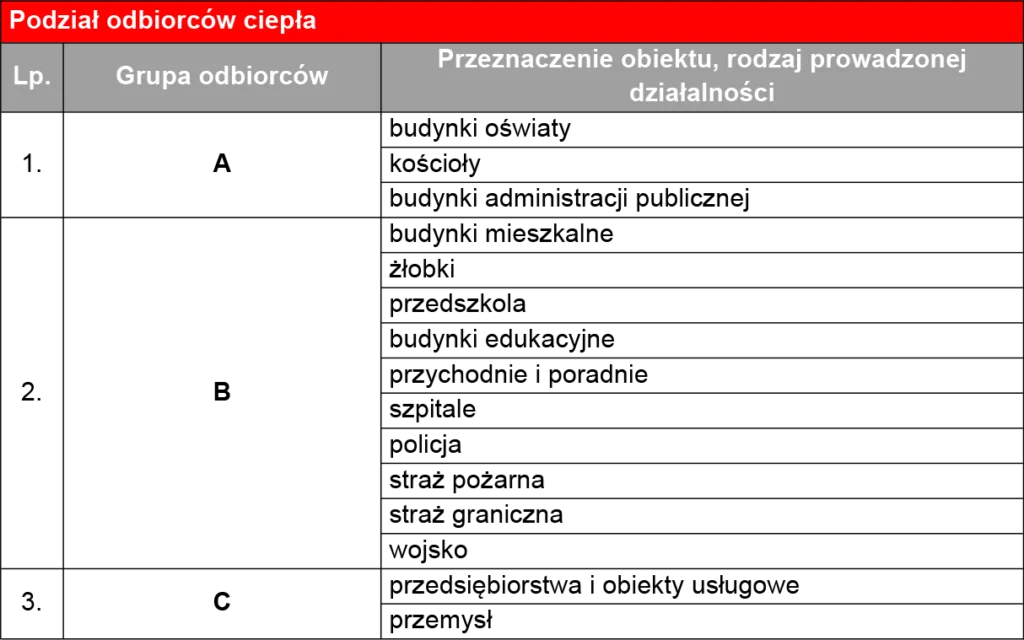
Heat consumers supplied from individual heat sources were divided into groups taking into account the purpose of the facility and the activity carried out:.
Table 2. Classification of heat consumers by building purpose and type of activity conducted
6.2 Consumers excluded from the restriction plan
In accordance with the Regulation of the Council of Ministers of 8 November 2021, customers in Group “B” are protected from restrictions, i.e.:
- residential buildings,
- nurseries,
- kindergartens,
- outpatient clinics and medical practices,
- hospitals,
- police,
- fire brigade,
- border guard,
- military.
The scope of protection against restrictions includes applying restrictions to customers subject to such protection as a last priority.
6.3 Levels of heat supply restrictions
Depending on the energy situation in the country and in Szczecin, as well as instructions from government or local authorities, the following levels of heat supply restrictions may be introduced.
Table 3. Levels of heat supply restrictions
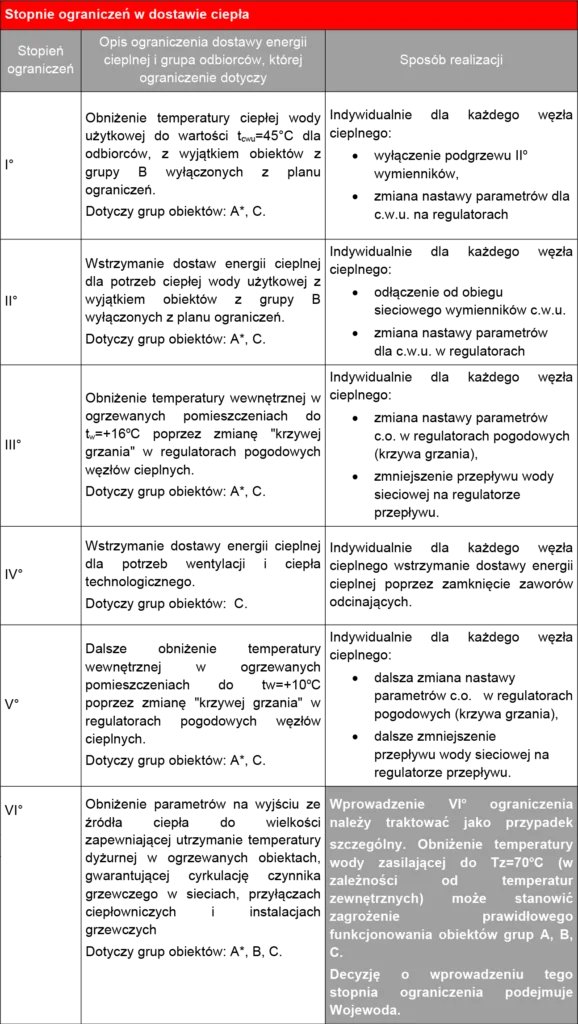
Restrictions on heat supply to educational buildings will be introduced after consultation with the managers of these facilities, due to the fact that some buildings in this group have mixed use corresponding to both Group A and Group B (buildings intended for permanent human occupancy as well as educational facilities).
6.4 Control table of the heat transfer medium for individual levels of heat supply restrictions
Heat is supplied to customers from heat sources via district heating networks. All sources operate on one common, open district heating network. Both facilities subject to heat supply restrictions and those excluded from such restrictions are supplied from the same district heating network. This limits the method of introducing restrictions to local measures, i.e. directly at the facilities subject to them.
Heat supply restrictions may be implemented by lowering the set temperatures for central heating and domestic hot water at customers’ heat substations, i.e. by reducing the heat transfer medium temperatures specified in the control table, or by limiting the quantity of the heat transfer medium supplied to the customer to the maximum restriction levels applicable to individual customer groups. Therefore, for individual levels of heat supply restrictions, a heat transfer medium control table will be applied (Appendix No. 3), and changes in the quantity of the heat transfer medium will be regulated at the customers’ premises on the primary side at individual heat substations.
When introducing restrictions, it is recommended to operate building heating systems in such a way that rooms occupied by people are heated, while sections of heating installations in rooms where people do not stay or stay only for short periods are shut off. In crisis situations, this method of heating will allow higher thermal comfort to be achieved in some rooms at the expense of reduced comfort in others, while always ensuring the safety of heating installations.
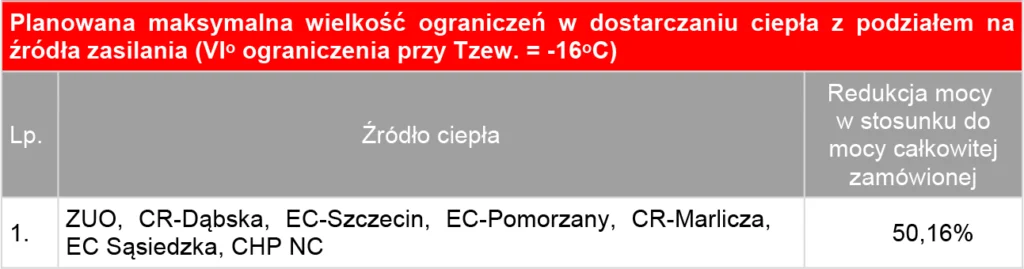
6.5 Planned maximum level of heat supply restrictions by supply source
Table 4. Planned maximum level of heat supply restrictions by supply source (Level VI restrictions at Tout = −16°C)
7. Method of public disclosure of the restriction plan
After the plan has been approved by the West Pomeranian Voivode, SEC will make the “Plan for restrictions on heat supply to customers in the city of Szczecin for the years 2024–2027” available on its website.
The decision to introduce restrictions on heat supply is taken by the Management Board of SEC.
The Management Board of the Company will notify the West Pomeranian Voivode in advance of the intention, reasons and scope of introducing restrictions on heat supply.
In case of planned introduction of restrictions, customers will be notified individually in writing, additionally through information published on the company’s website, as well as by issuing relevant announcements in local media.
8. Validity of the heat supply restriction plan for customers within SEC’s operating area in Szczecin
The plan for introducing restrictions on heat supply to customers within SEC’s operating area in Szczecin for the years 2024–2027 is valid from 01.07.2024 to 01.07.2027.
Appendices
Appendix No. 1 – District heating system diagram
Appendix No. 2 – Network water temperature table for heat sources
Appendix No. 3 – Heat transfer medium control table for individual levels of heat supply restrictions for water with parameters 125/65°C
Appendix No. 4 – Heat transfer medium control table for individual levels of heat supply restrictions for water with parameters 115/60°C
